shamnaop.com

Author name: buildwithshamna@gmail.com

Uncategorized

The Digital Marketing Trend I Actually Use Every Day (And Why It’s Not What You Think)

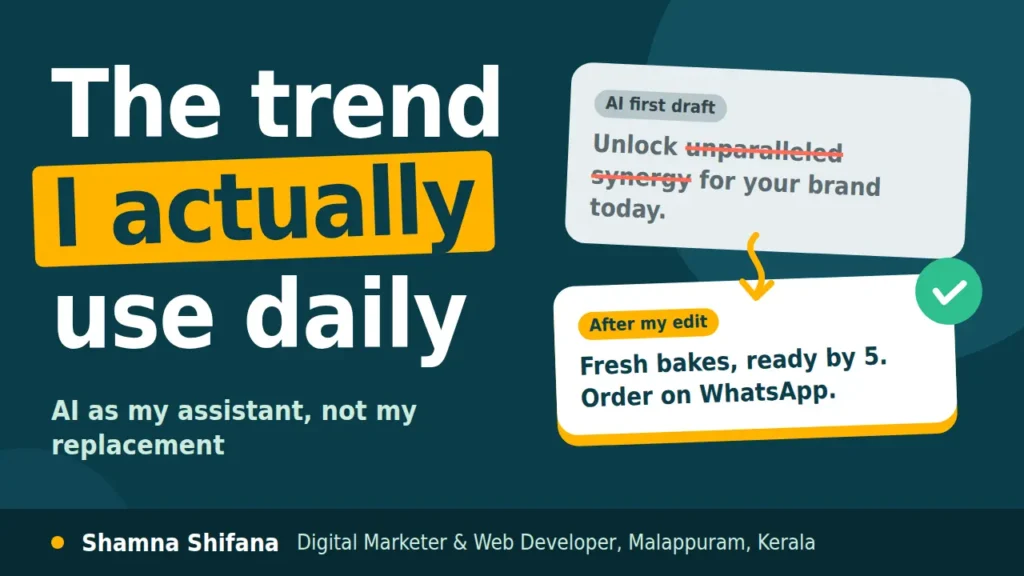
The Digital Marketing Trend I Actually Use Every Day (And Why It’s Not What You Think) Every few months, a new “must-follow” trend shows up in my feed. Some are useful. Most are noise with a nice thumbnail. So when I was asked which digital marketing trend I find useful, I had to think about it honestly. Not the one that sounds impressive in a pitch deck, but the one I’d miss if it disappeared tomorrow. My answer is using AI as a working assistant, not as a replacement for thinking. How I ended up here I’m Shamna, a Multimedia graduate from Calicut University, and I now work as a freelance digital marketer and web developer here in Malappuram, Kerala. When I started, I did everything the slow way. Keyword research took hours. Writing ten caption options for a single post meant staring at a blank screen with a cold cup of chai. Then I began using AI tools, first out of curiosity, then out of necessity. My early attempts were bad. I’d paste in a prompt, get a stiff, polished paragraph back, and post it. It read like a brochure written by someone who had never met a customer. Engagement was flat, and I knew why. The tool wasn’t the problem. I was asking it to do my job instead of helping me do it. Where AI genuinely helps me Now I use it for the boring, heavy parts of the work. Research. When I take on a new client, say a small bakery or a coaching institute, I use AI to quickly map out what people search for around that business. What questions do customers ask? What words do they use? It gives me a starting list in minutes, which I then check against real search data and my own judgment. First drafts of structure, not voice. I ask for outlines, headline options, or different ways to organise a page. I rarely keep the wording. I keep the skeleton and rewrite the rest in a tone that sounds like the actual business owner. Repurposing. One good blog post can become a few social captions, an email snippet, and a short video script. AI speeds up that first pass. I edit every piece so it feels natural for its platform. Spotting gaps. Sometimes I paste in a page I’ve built and ask what a first-time visitor might still be confused about. It’s like having someone read over my shoulder, though I don’t always agree with the answer. What I never hand over There are things I don’t outsource, and this is where most people go wrong. I don’t let AI decide the strategy. It doesn’t know that a family-run shop in Malappuram gets most of its customers through word of mouth and WhatsApp, or that a festival week changes what people buy. It doesn’t know which tone will feel trustworthy to a local audience and which will feel like an ad from another city. I also never publish anything I haven’t read out loud. If a sentence sounds like nobody would say it in real life, it goes. Readers can feel when something was written to fill space, and search engines are getting better at feeling it too. Why this matters for local businesses A lot of small businesses in Kerala are still deciding whether digital marketing is worth the effort. I understand the hesitation. Many have been burned by agencies promising overnight results. Here’s what I’ve seen working: local SEO combined with honest, useful content. When someone in Kochi, Kozhikode or Malappuram searches for a service “near me”, the business that shows up with a clear Google Business profile, a fast website, and content that answers real questions usually wins. It’s not glamorous. But it compounds. AI lets a freelancer like me deliver this level of work at a pace and price that small businesses can actually afford. That’s the real shift. It isn’t about replacing people. It’s about making good marketing reachable for shops and startups that never had a big budget. Being a web developer helps Since I also build websites, I see marketing and design as one job. A beautiful campaign sends people to a slow, confusing page, and the whole effort falls apart. So I care about page speed, mobile layout, clean structure, and simple navigation as much as I care about keywords. AI helps here too. It’s useful for debugging a stubborn bit of code or drafting meta descriptions. But the decisions about what a visitor should see first, and where they should click next, still come from testing and common sense. A few honest lessons If you’re thinking about bringing AI into your own marketing, here’s what I’d tell a friend over tea. Start small. Pick one task that eats your time and try it there first. Always edit the output until it sounds like you. Check every fact, because these tools can be confidently wrong. And keep talking to real customers, because no tool replaces that. The trend isn’t the tool. The trend is that individuals and small teams can now do work that once needed a whole department. What you do with that time, whether you spend it on better ideas, better design, or better conversations, is what separates useful marketing from more noise. Final thoughts If I had to sum it up, the most useful trend in digital marketing right now is the one that gives you time back to think like a human. If you’re a business owner looking for an AI-savvy digital marketing freelancer in Malappuram, Kerala, or you simply want to talk about SEO, branding, or building a website that actually brings in customers, I’d be glad to chat. Let’s build something that sounds like you, not like everyone else.
Uncategorized

Is Learning Digital Marketing From Zero Actually Possible?

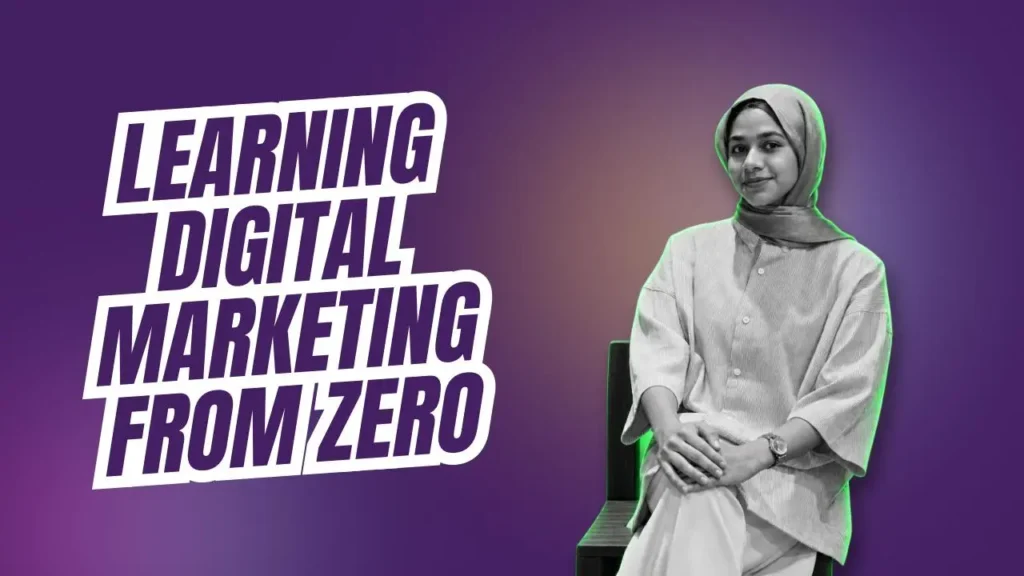
Is Learning Digital Marketing From Zero Actually Possible? I still remember the exact evening I decided to learn digital marketing. I had no design background, no coding experience, and definitely no idea what “SEO” even stood for. I was sitting with a laptop that felt more like a paperweight than a tool, staring at a YouTube tutorial titled “Digital Marketing Full Course,” feeling completely lost within the first ten minutes. If you’re reading this wondering whether you can actually start from absolute zero and build a real career in this field, I want to tell you — yes, you can. I did it, and I’m writing this today as an AI integrated digital marketing strategist working out of Malappuram, Kerala, India. But let’s be honest about something first. Nobody tells you how messy the beginning actually is. The Myth of the “Perfect Starting Point” Every course, every ad, every guru online makes it sound like there’s a clean, linear path — learn SEO, then social media, then paid ads, then you’re a marketer. In reality, learning digital marketing from scratch feels more like throwing spaghetti at a wall and slowly figuring out which strands actually stick for you. I spent my first few months bouncing between free YouTube videos, half-finished Udemy courses, and Google’s own training modules, not really sure what I was building toward. What changed things for me wasn’t finding the “right” course. It was picking one skill and going stupidly deep into it before moving to the next. For me, that skill was content writing. I started writing blog posts for free, for anyone who’d let me, just to understand how words could actually move someone toward an action. That’s where my journey as an SEO content creator quietly began, long before I called myself one. Why Zero Experience Isn’t the Handicap You Think It Is Here’s something nobody told me back then: digital marketing rewards curiosity more than credentials. I’ve met people with marketing degrees who struggle to write a decent Instagram caption, and self-taught folks who understand consumer psychology better than most agencies. The field moves so fast — especially now with AI tools reshaping how content gets created and distributed — that formal education often lags behind what’s actually happening in the industry. Starting from zero actually gave me an advantage in one specific way. I wasn’t unlearning outdated habits. I built my understanding around how the internet works today, not five years ago. When AI tools started becoming genuinely useful for keyword research, content outlines, and even coding assistance, I picked them up naturally instead of resisting them the way some experienced marketers initially did. The Web Development Detour Nobody Warns You About Somewhere around year one, I realized that understanding marketing without understanding websites was like being a chef who’s never seen a kitchen. So I taught myself basic web development — nothing fancy at first, just enough HTML and CSS to understand why a landing page converts better than another. That decision ended up being one of the smartest accidental choices I made. Today, being able to function as both a marketer and a web developer means I can build a campaign and the page it lives on, without waiting on someone else’s schedule. If you’re learning from zero, don’t skip this part just because it feels technical or intimidating. You don’t need to become a full-stack developer. You just need enough understanding to not feel helpless when a client says “the page isn’t loading properly” or “can you tweak this button.” Where Location Actually Doesn’t Matter Being based in Malappuram, Kerala, I used to worry that opportunities were concentrated in Bangalore, Mumbai, or Delhi. Turns out, digital marketing is one of the rare careers where your postal code barely matters. Clients don’t care whether you’re sitting in a metro city or a small town in Kerala — they care whether your SEO strategy works and whether your content converts. Some of my most consistent clients have never asked where I’m physically located, and honestly, most don’t know until it comes up naturally in conversation. If anything, working as a digital marketer in Malappuram, Kerala forced me to rely more on proof of work than on networking circles or city-based reputation. That pushed me to build a stronger portfolio, faster, than I might have if I’d had easier access to industry events and in-person mentors. What I’d Tell Someone Starting Today Pick one skill. Get uncomfortably good at it before adding the next layer. Don’t wait to feel “ready” before taking on your first real project, even if it’s unpaid or for a friend’s small business. Use AI tools to speed up your learning curve, but don’t let them replace your own judgment — clients can tell the difference between generic AI-polished work and something with real thought behind it. And most importantly, document your journey somewhere. Write about what you’re learning, even messily. That habit alone — turning confusion into content — is basically the entire skillset of an SEO content creator in disguise. Final Thought uncomfortable, unglamorous, and slower than the courses promise. But if you stay curious, build real things instead of just watching tutorials, and let go of the idea that you need permission to start, you’ll get there. I did — sitting right here in Malappuram, Kerala — and there’s genuinely no reason you can’t too.

Uncategorized

Is Growing a Personal Brand on Substack a Good Way to Showcase Skills to Recruiters?

Is Growing a Personal Brand on Substack a Good Way to Showcase Skills to Recruiters? A few months back, someone messaged me on LinkedIn asking a simple question: “Why do you write on Substack instead of just updating your resume?” It’s a fair question, and honestly, one I get a lot as a digital marketer in Malappuram, Kerala. My answer usually surprises people — because a newsletter, done right, tells a story that a resume simply can’t. I work as an AI integrated digital marketing strategist in Malappuram, Kerala, India, wearing three hats at once — SEO content creator, web developer, and someone who’s constantly experimenting with how AI tools fit into everyday marketing work. Over the last year or so, I’ve been building a small but steady readership on Substack, and it’s changed the way I think about job hunting, freelancing, and even client conversations. So let me walk you through why I think it’s worth your time too. Resumes Tell, Newsletters Show Anyone can write “SEO expert” or “skilled in content strategy” on a resume. Recruiters see that phrase a hundred times a day, and honestly, it means very little without proof. A Substack changes that equation. When you publish regularly about SEO experiments you’ve run, campaigns that flopped and why, or how you used an AI tool to cut content production time in half, you’re not claiming a skill — you’re demonstrating it in real time. Think about it from a hiring manager’s perspective. They can either trust three bullet points on a PDF, or they can read six months of your actual thinking, your writing voice, and how you solve problems. The second option builds trust faster than any cover letter ever could It Works Especially Well for Digital Marketing Roles There’s something almost poetic about using content marketing to prove you’re good at content marketing. If you’re applying for roles that involve SEO, copywriting, or web development, your Substack becomes a living portfolio. Every post is evidence: here’s how I structure headlines, here’s how I think about keyword intent, here’s a landing page I coded and the reasoning behind the design choices. As someone based in Malappuram, Kerala, working with clients across India and occasionally overseas, I’ve noticed that a consistent newsletter also solves a location problem. Recruiters searching for a digital marketer in Malappuram, Kerala often assume talent pools in tier-two and tier-three cities are limited. A well-written, well-optimized Substack quietly challenges that assumption. It shows you’re plugged into global trends — AI tools, algorithm updates, content strategy shifts — regardless of your postal code. The SEO Angle Nobody Talks About Here’s something most people miss: your Substack posts, if written well, get indexed by Google. That means every article you publish is also a small SEO asset working in your favor. When someone searches for terms like “AI integrated digital marketing strategist Malappuram” or similar phrases, a consistently published newsletter with genuine expertise has a real shot at showing up. It’s not just personal branding anymore — it’s organic visibility that a static resume simply cannot generate. As an SEO content creator, I treat every Substack post the way I’d treat a client’s blog: proper structure, natural keyword placement, internal links back to my portfolio, and genuinely useful information. That discipline itself becomes proof of skill. But It’s Not a Magic Bullet I don’t want to oversell this. A Substack with three posts and a six-month gap does more harm than good. Recruiters notice inconsistency the same way they notice typos. If you’re going to start one, commit to a rhythm — even if it’s just twice a month. Quality matters more than frequency, but consistency matters more than either. Also, don’t turn it into a diary. Recruiters aren’t scrolling through your newsletter for personal updates; they want to see thinking, process, and results. Write about the campaign that underperformed and what you learned. Break down a web development project step by step. Explain why you chose one AI tool over another for a client’s content calendar. That’s the stuff that actually gets noticed. How I Use Mine My own Substack mixes three things — SEO breakdowns from real projects, thoughts on where AI is genuinely useful versus overhyped in marketing, and behind-the-scenes notes from web development work I’ve done for local businesses here in Kerala. It’s not polished corporate content. It reads like a person figuring things out in public, because that’s exactly what it is. And that authenticity, more than any keyword stuffing or clever headline, is what seems to resonate with people who eventually reach out — whether they’re recruiters, potential clients, or just fellow marketers curious about the same questions Final Thought So, is growing a personal brand on Substack a good way to showcase your skills to recruiters? In my experience, yes — but only if you treat it as a portfolio, not a diary. Write like someone is actually going to hire you based on what they read. Be specific, be consistent, and let your expertise as an SEO content creator, web developer, or digital marketing strategist show through the work itself, not just the job titles you list. If you’re a digital marketer in Malappuram, Kerala, or anywhere else trying to stand out in a crowded field, this might just be the low-cost, high-honesty portfolio you’ve been looking for.

Uncategorized

The Future of Marketing in the AI Era: A Digital Marketer’s Perspective from Malappuram, Kerala

The Future of Marketing in the AI Era: A Digital Marketer’s Perspective from Malappuram, Kerala A few years ago, if you had told me that I would be writing content briefs for an AI, training chatbots to sound like brands, and building campaigns around search engines that answer questions instead of just listing links, I would have laughed. Back then, marketing meant catchy taglines, print ads, and the occasional Facebook boost post. Today, sitting right here in Malappuram, Kerala, and working as a digital marketing strategist for clients across India and beyond, I can say with confidence — marketing has changed more in the last three years than it did in the previous fifteen. And the biggest reason for that shift has one name: Artificial Intelligence. Marketing Is No Longer Just Creative — It’s Intelligent For the longest time, marketing was seen as the “creative” department. Great copy, beautiful design, a catchy jingle — that was the formula. AI hasn’t killed creativity, but it has forced it to grow up. Today, creativity has to work hand-in-hand with data, automation, and intelligent decision-making. As someone who works as an AI integrated digital marketing strategist, I’ve seen this shift firsthand. Clients no longer just ask “can you make this look good?” They ask “can you make this convert?” And that’s where AI comes in — not as a replacement for human thinking, but as a partner that helps us think faster, test more ideas, and understand customers on a level we simply couldn’t before. Why Local Businesses in Kerala Need to Pay Attention I work with a lot of local businesses here in Malappuram and across Kerala — textile shops, real estate developers, educational institutes, home-based businesses, and small startups. A common misconception I run into is that AI-powered marketing is only for big brands with big budgets. That’s simply not true anymore. Tools driven by AI have made it possible for a small business in a small town to run smarter ad campaigns, understand exactly what their customers are searching for, and create content that actually ranks — without needing a massive marketing team. As an SEO content creator, I’ve watched search behavior change dramatically. People aren’t just typing three keywords into Google anymore; they’re asking full questions, expecting real answers, often through voice search or AI-powered search summaries. If your content isn’t built to answer real human questions clearly and honestly, it simply won’t be found — no matter how many keywords you stuff into it. This is exactly why the future of SEO isn’t about tricking algorithms. It’s about genuinely understanding your audience, and using AI tools to do that understanding at scale. The Human Touch Is Actually More Important Now Here’s something I tell every client, every student, and every young marketer who reaches out to me for advice: the more AI takes over the technical and repetitive parts of marketing, the more valuable genuine human connection becomes. Anyone can now generate a blog post in seconds. Anyone can create a decent looking ad graphic with a few prompts. So what separates a brand that grows from one that gets lost in the noise? Authenticity. Storytelling. Local relevance. Trust. When I write content for a business here in Malappuram, I don’t just think about search rankings. I think about how a real customer in Kerala — someone who understands our culture, our language nuances, our local festivals and buying habits — will feel reading it. AI can help me structure that content, research faster, and optimize it for search engines, but the soul of the message still has to come from real understanding of real people. That part can never be automated. Where I See Marketing Heading in the Next Few Years Based on what I’m seeing every day in client work and industry trends, here’s what I believe the next phase of marketing will look like: Hyper-personalization will become the norm. Generic ads and generic emails will lose effectiveness. Businesses that use AI to understand individual customer behavior and personalize their messaging will win the attention war. Search itself is evolving. With AI-driven search experiences becoming more common, ranking well will depend less on keyword tricks and more on being a genuinely trustworthy, well-structured source of information. Video and voice will dominate even more. As AI makes video editing and voice content creation faster and more accessible, businesses that embrace these formats early will have a real advantage. Local SEO will matter more than ever, not less. As AI search tools get better at understanding location-based intent, businesses that build a strong, authentic local presence — especially here in places like Malappuram and across Kerala — will be rewarded. Marketers will become strategists, not just executors. The role of a digital marketer is shifting from “person who posts content” to “person who understands data, AI tools, customer psychology, and brand storytelling all at once.” My Final Thought AI is not here to replace marketers. It’s here to replace outdated marketing methods. The professionals and businesses who learn to work alongside AI — using it for speed and insight while keeping their strategy deeply human — are the ones who will thrive in this new era. As someone building a career and a client base right here in Malappuram, Kerala, I genuinely believe this is one of the most exciting times to be in marketing. The tools have changed, the expectations have changed, but the goal remains the same: connect real businesses with real people, in a way that feels honest and valuable. The future of marketing isn’t AI versus humans. It’s AI powered by human insight — and that’s exactly the kind of marketing I want to keep building, one campaign at a time. Looking for an AI integrated digital marketing strategist in Malappuram, Kerala, or need help with SEO-focused content that actually connects with your audience? Feel free to reach out — let’s build something that works for your business, not just for the algorithm.

Scroll to Top